


Posted on
What Makes a Strong Woman-Owned Franchise Business in CertaPro Painters?
Learn which leadership traits, support systems, financial habits, and operating practices help build a strong woman-owned franchise business.
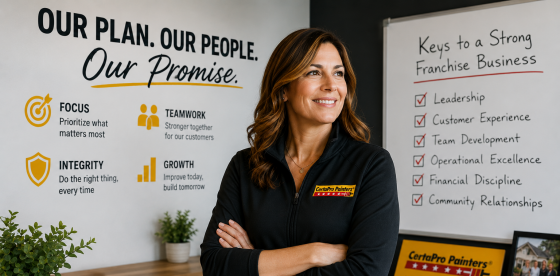
Women arrive at franchise ownership from corporate management, healthcare, education, sales, finance, operations, hospitality, and marketing. Those backgrounds transfer well. But what separates a strong local painting business from an average one isn’t background — it’s a short list of operating behaviors, most of which are measurable, and several of which competitors routinely get wrong.
For women evaluating franchise ownership opportunities, those specifics are more useful than a list of admirable qualities. Here’s what actually moves the needle.
Quick Answer
A strong woman-owned franchise business is built through clear leadership, disciplined operations, financial management, customer relationships, team development, and consistent use of the franchise system. Support, training, and brand resources can provide structure, but the owner remains responsible for local execution and long-term direction.
Speed Is the Cheapest Advantage Available
When a homeowner decides to get their house painted, they rarely contact one company. They fill out three forms in ten minutes and wait. Whoever calls back first is usually having a conversation while the others are still a notification.
The research on this is blunt. A study by James Oldroyd of MIT Sloan and Dave Elkington of InsideSales found that calling a new lead within five minutes rather than thirty produced roughly 21 times the odds of qualifying it — and about 100 times the odds of reaching a live person at all. Waiting from five minutes to ten cut the odds by a factor of four.
This is the most undervalued thing a small home service business controls. It costs nothing. It requires no additional marketing spend. It is purely a question of whether the owner has built a process that catches inbound leads immediately instead of at the end of the day. Owners who treat follow-up as an operating standard rather than an intention tend to win a disproportionate share of the estimates they’re invited to.
Strong businesses are built through operating discipline.
Motivation may help an owner begin, but repeatable systems, accountability, and consistent follow-through are what help the business operate reliably over time.
Reputation Is Public, and It Expires
Painting is a trust purchase. Customers hand over keys, pay in advance of a finished result, and have no way to verify quality until the work is done. So they outsource the judgment to strangers online.
BrightLocal’s 2026 Local Consumer Review Survey found that 97% of consumers read reviews when choosing a local business, and 41% say they always do — up from 29% a year earlier. The detail that matters most for a service business: 74% specifically look for reviews written in the last three months, and nearly a third want something from the last two weeks. A wall of five-star reviews from 2023 reads as a business that used to be good.
Reviews also aren’t a one-way channel anymore. The same survey found 89% of consumers expect owners to respond, 42% are unlikely to use a business that never replies, and half are put off by responses that read as templated. That last point is worth sitting with, because the obvious shortcut — a canned thank-you on every review — actively costs trust.
What this means practically: review generation belongs in the production process, not in a quarterly marketing push. Every completed project is the moment to ask, and every response should sound like a person wrote it.
Hiring Is the Constraint, Not Ambition
Most owners assume demand will be the hard part. In the trades, it’s usually labor. Associated Builders and Contractors estimates the construction industry needs to attract roughly 349,000 net new workers in 2026, with most of that demand coming from replacing retirements rather than from growth. The people leaving the trades outnumber the ones entering.
A business that can sell more than it can produce has a scheduling problem, unhappy customers, and no way to grow. So recruiting isn’t a task that happens when someone quits — it’s an ongoing function, the same as marketing.
Building the team is also where delegation either works or collapses. Handing off a responsibility without defining the expected result, the standard, the deadline, which decisions the person can make alone, and what requires escalation produces confusion rather than relief. The owner takes the work back and concludes that nobody else can do it. Done properly, delegation transfers real authority while the owner stays accountable for the standard.
Use the System — and Know When It Isn’t the Problem
The value of an established model is that someone already paid for the mistakes. Estimating methods, sales process, marketing programs, technology, and customer service standards arrive tested. That advantage only exists if the owner actually runs them as designed long enough to see what they produce.
The real skill is diagnostic. When results disappoint, a strong owner figures out whether the cause is the system, the local market, her own execution, or a gap that needs support — rather than abandoning the model at the first bad month or defending it through a bad year. Most underperformance traces back to execution, which is the good news, because execution is the part she controls.
That’s also what makes support worth using. Coaches, franchise support staff, and other owners who have solved the same problem are faster than figuring it out alone. The franchise training and support resources available through CertaPro Painters cover how those resources work, and the franchise owner testimonials show how differently owners put them to use.
What Traits Support Strong Franchise Ownership?
-
Accountability
Taking responsibility for decisions, performance, and the local customer experience.
-
Resilience
Continuing to lead when hiring, customer, financial, or operational challenges appear.
-
Curiosity
Asking questions, reviewing performance, and remaining willing to learn.
-
Decisiveness
Making informed decisions without waiting for perfect certainty.
Decisiveness deserves a note, because it’s the one that separates owners who adapt from owners who stall. Conditions shift constantly — a marketing channel stops performing, a crew lead quits, material costs move. The job isn’t to react to every fluctuation or to wait for certainty that won’t arrive. It’s to tell the difference between noise and a trend, then act on the trend while it’s still cheap to fix.
Could Painting Franchise Ownership Be Your Next Step?
Learn more about the CertaPro Painters® franchise model, training structure, investment requirements, and what ownership may involve.
Frequently Asked Questions
What makes a strong woman-owned franchise business?
A strong woman-owned franchise business is built through leadership, consistent execution, financial awareness, customer service, team development, and effective use of the franchise system. Individual results depend on the owner, market, investment, and other operating factors.
Do women need prior business ownership experience to run a franchise?
Prior ownership experience may be useful, but it is not the only relevant background. Leadership, sales, customer service, operations, financial management, and team-development experience can all transfer into franchise ownership.
Which traits are most important for a franchise owner?
Important traits may include accountability, resilience, communication, decisiveness, financial awareness, willingness to learn, and the ability to lead people through changing conditions.
How does franchise support contribute to business strength?
Franchise support may provide training, operating systems, marketing resources, technology, coaching, and peer connections. These resources can provide structure, but the local owner remains responsible for execution and business performance.
Does a strong owner need to manage every task personally?
No. Strong owners often build teams, define responsibilities, and delegate work as the business develops. The owner remains accountable for the operation even when specific responsibilities are assigned to others.
What should women review before investing in a franchise?
Prospective owners should review the investment, daily responsibilities, local market, training, support, ongoing fees, staffing needs, franchise agreement, and Franchise Disclosure Document before making a decision.
Each CertaPro Painters® business is independently owned and operated. Franchise ownership involves risk, and individual results vary based on market conditions, investment, management, execution, and other factors. Nothing in this article constitutes a guarantee of financial or business performance.