


Posted on
Why More Women Are Choosing Franchise Ownership in Home Services
Learn why more women are choosing home service franchise ownership to lead teams, serve local markets, and build long-term business value.
Home services isn’t the first category most people picture when they think about women entrepreneurs. It should be closer to the front of the list.
The model rewards exactly what a lot of women already do well — leading teams, managing customer relationships, running operations, holding standards — and asks for very little of what they don’t have, namely trade experience. The owner of a painting business doesn’t paint. She builds the company that paints.
For women exploring franchise ownership opportunities, here’s what makes the category worth a serious look, and what it genuinely demands in return.
Quick Answer
Women are increasingly drawn to home service franchise ownership because it combines local market demand with an established business model, training, operational systems, customer relationships, and room to build a team. The owner leads the business rather than personally completing every service.
The Demand Isn’t a Trend
Most business categories require convincing people they need something. Home services doesn’t. Paint fails, siding weathers, units turn over between tenants, and houses get prepped before they’re listed. The work exists whether or not anyone is marketing.
The numbers behind that are substantial. Harvard’s Joint Center for Housing Studies projects owner-occupied home improvement and repair spending of roughly $523 billion a year heading into 2027.
And according to the International Franchise Association’s 2026 home services spotlight, home services is expected to post the strongest growth of any franchised industry this year, with sector output projected above $143 billion.
What’s driving it is a durable shift in who does the work. Boomers hold a large share of the housing stock and increasingly prefer to hire out physical upkeep rather than handle it themselves. Younger dual-income households are moving the same direction for a different reason — time. Both groups are converting what used to be weekend projects into service calls.
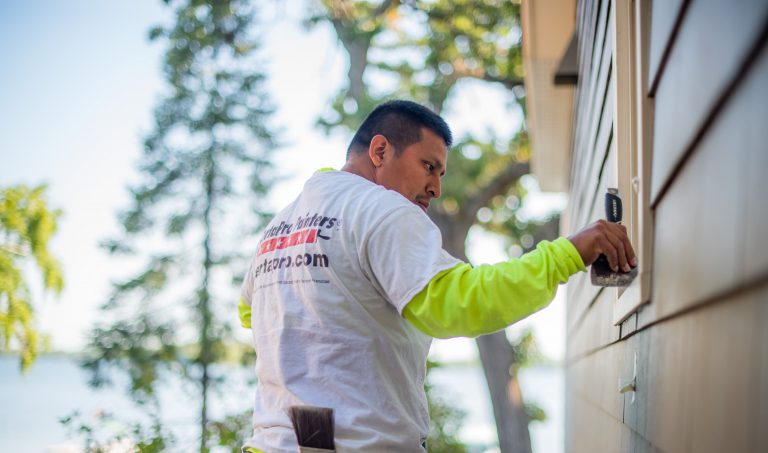
The Owner Doesn’t Hold the Brush
This is the misconception that keeps qualified people out of the category. In a painting franchise, the owner’s week looks like running any service business: reviewing inbound inquiries, managing estimates and sales, coordinating project schedules, supporting crews, tracking customer satisfaction, watching the marketing spend, and reading the financials closely enough to know which jobs actually made money.
That’s a general management job. It opens the door to anyone whose strengths are leadership, sales, communication, and operations rather than technical trade skill — and it scales in directions a solo trade career can’t, including commercial painting work for property managers and facility teams, which runs on schedules and contracts rather than seasonal homeowner demand.
Ownership is a Leadership Role in Home Services
The owner creates the systems, team structure, customer experience, and operating discipline that allow the technical work to be delivered consistently.
The Skills That Decide It
-
Leadership
Setting expectations, coaching people, making decisions, and maintaining accountability.
-
Customer Communication
Listening to customer concerns, explaining solutions, and managing expectations clearly.
-
Organization
Coordinating schedules, projects, follow-up, documentation, and multiple priorities.
-
Financial Judgment
Reviewing costs, budgets, performance, and the financial implications of business decisions.
These aren’t soft supplements to the “real” work. In home services they are the real work. Technical quality is table stakes — customers assume competence and judge everything else. Whether the company called back quickly, whether the estimate made sense, whether the crew showed up when promised, whether someone followed up afterward. An operator who handles those reliably stands out in a field where plenty of competitors don’t.
An Established Model Shortens the Runway
Launching independently means answering a long list of questions before serving a single customer: how to position the brand, how to build estimates, which software to run, how inquiries get routed, how a job moves from sale to completion, how performance gets measured. Every one of those is a guess made without operating experience, and some of them are expensive guesses.
A franchise supplies tested starting answers. The owner still carries local execution — that part never transfers — but she isn’t designing the machine and running it simultaneously in year one. The CertaPro Painters franchise training and support system covers how owners learn the model, and the CertaPro Painters franchise story gives background on how the system developed.
An established brand helps at the front of the funnel too. Recognition makes a homeowner comfortable enough to request the estimate. It doesn’t close the sale or satisfy the customer — the local team does that. The brand opens the door; execution decides what happens next.
A Local Market Is Finite and Winnable
Most modern businesses compete in an unbounded market against an unlimited number of rivals. A home service business competes inside a defined territory against a countable number of local operators, many of them one or two trucks and no systems.
That changes how growth feels. Business development becomes concrete: homeowners, property managers, real estate agents, commercial property owners, community groups, referral partners. These are people you can meet. Reputation compounds in a way it never does online, because the neighbor who watched your crew work for three days is a warmer lead than any ad. For an owner who wants a visible presence in her community rather than anonymity in a marketplace, that’s a feature, not a limitation.
What to Look At Before Deciding
The category being attractive doesn’t make any particular opportunity right. The things worth real scrutiny are the owner’s daily responsibilities, the initial investment and working capital, ongoing fees, the training program, marketing and technology support, staffing requirements, and the specific local market in front of you.
The CertaPro Painters franchise investment information is a starting point on the financial side, and the franchise evaluation process shows how the conversations unfold. For sharper questions to bring into them, see how to evaluate a franchise brand, and the franchise owner testimonials show how people from different backgrounds approached the decision. Independent legal, financial, and tax guidance belongs in the process as well.
Then there are the questions only you can answer. Am I comfortable leading crews and contractors? Do I actually enjoy customers, or just tolerate them? Am I willing to sell personally for the first couple of years? Can I follow a system I didn’t design? Do I have the capital to absorb a slower ramp than I’m planning for?
The strongest ownership decisions come from alignment rather than aspiration. The demand in this category is real and the model is proven. What determines the outcome is whether the person running it wants the job that actually exists — building a team, serving customers, holding standards, and making disciplined calls year after year.
Could Painting Franchise Ownership Be Your Next Step?
Learn more about the CertaPro Painters® franchise model, training structure, investment requirements, and what ownership may involve.
Frequently Asked Questions
Why are more women choosing home service franchises?
Home service franchises can offer established systems, local demand, customer-facing work, team-building opportunities, and a path into ownership that does not always require the owner to perform the technical service herself.
Do women need trade experience to own a home service franchise?
Direct trade experience may be helpful, but it is not always required. Leadership, sales, customer service, operations, organization, and team-management skills can be highly relevant to the owner’s role.
What does a painting franchise owner do?
A painting franchise owner generally leads the business by managing customers, sales, team members, scheduling, local marketing, financial performance, and business development while painting crews complete the project work.
Can a home service franchise become less dependent on the owner?
Over time, documented systems, delegation, and team development may allow an owner to reduce personal involvement in every daily task. Results and timelines vary by business, market, staffing, and execution.
What should women evaluate before buying a home service franchise?
Prospective owners should review the investment, daily responsibilities, local market, training, support, staffing needs, ongoing fees, and Franchise Disclosure Document before making a decision.
Each CertaPro Painters® business is independently owned and operated. Franchise ownership involves risk, and individual results vary based on market conditions, investment, management, execution, and other factors. Nothing in this article constitutes a guarantee of financial or business performance.